
We design complete energy cost reduction strategies for businesses — photovoltaic generation, storage and collective self-consumption management — with advanced engineering design, not generic estimates. Focused on systems from 20 kW to 1 MW, with no upper limit for larger-scale projects, including off-grid solutions and custom OEM integrations.
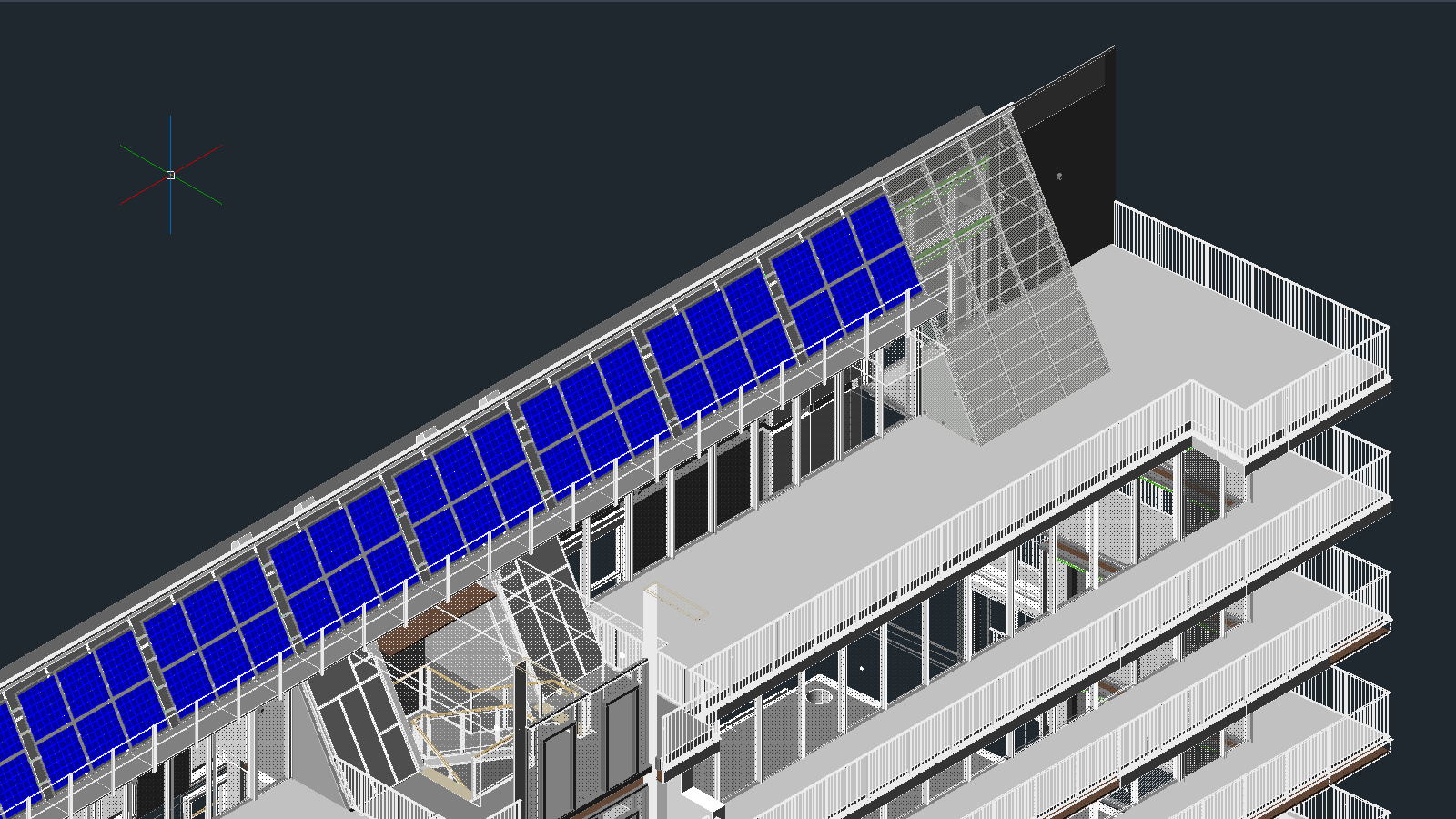 3D MODEL · REAL PROJECT
Focused on systems from 20 kW to 1 MW, with no upper limit for larger-scale projects: photovoltaic generation, storage and collective self-consumption management — including off-grid systems and custom OEM projects. Every project starts with a technical study, not a catalogue.
Photovoltaic systems sized to the company's real consumption curve, with intelligent management of power peaks.
Integrated batteries to maximise self-consumption, ensure operational continuity and prepare the business for dynamic tariffs.
Energy generation and sharing between associated facilities or businesses — a dedicated management model, distinct from Renewable Energy Communities (RECs).
Decades of experience in autonomous systems for locations without access to the electrical grid, with rigorous autonomy sizing — plus development of photovoltaic systems configured to OEM partner specifications, from engineering design to final integration.
Replacing diesel generators with direct solar pumping, no batteries required, integrated with centre pivots and boreholes. Shading management to maximise crop yields. A resource-reduction strategy addressing impact on soil, air, water consumption and gas emissions.
Generation, Storage, Consumption Reduction and Efficiency — your partner in implementing a consistent and sustainable ESG strategy, Environmental pillar.
We don't sell standalone equipment — we design and operate energy systems for businesses with real requirements.
In-house engineering team, capable of designing and managing multi-phase projects — focused between 20 kW and 1 MW, but with no upper limit for larger-scale projects, and custom integrations.
We work essentially with equipment of European origin, to improve sustainability, reduce carbon footprint, provide local technical support, and comply with European regulation, namely the NIS2 cybersecurity directive.
Monitoring, preventive maintenance and continuous technical response after installation — the system remains our responsibility.
Energy autonomy sizing for locations without grid access — a technical domain few companies in the sector master.
We don't use generic calculators. We apply methodologies based on a real technical survey of consumption, required power, and the most suitable storage strategy.
 UPAC1
N.01 / 15
UPAC1
N.01 / 15
It depends on the installed power and the consumption profile of the facility. In the Commercial and Industrial range, between 20 kW and 1 MW, the payback period is typically 2 to 5 years for generation, and 4 to 7 years for generation plus storage. The technical study will give you the exact figure for your case.
1. UPAC (Self-Consumption Production Unit)
What it is: The physical energy production equipment (for example, the set of solar panels and the inverter). Scope: It's the "hardware". It can belong to a single home/business (individual self-consumption) or be the energy source for shared projects (ACC or REC).
2. Collective Self-Consumption (ACC)
What it is: A group of neighbours, a condominium, or businesses within a defined area that share the energy generated by one or more UPACs. Focus: Reducing electricity bill costs for members. Structure: Does not require setting up a company or association. It's enough to sign an internal regulation and appoint a Managing Entity (EGAC).
3. REC (Renewable Energy Community)
What it is: A broader, more structured concept. It's a legal entity in its own right (usually a non-profit association or cooperative) formed by citizens, local authorities or small businesses. Focus: Bringing environmental, social and economic benefits to the local community (e.g. tackling energy poverty), going beyond a simple bill discount. Structure: It must be a legal entity, and can carry out additional activities such as managing EV chargers, community storage, or energy efficiency services.
Our project managers can explain this in more detail. Book your meeting now.
Yes — licensing with the DGEG (Directorate-General for Energy and Geology) is included in the engineering process, from the feasibility study to the system's final grid connection.
Continuous production monitoring, scheduled preventive maintenance and technical response in case of anomalies — to ensure the system's performance is maintained throughout its entire service life.
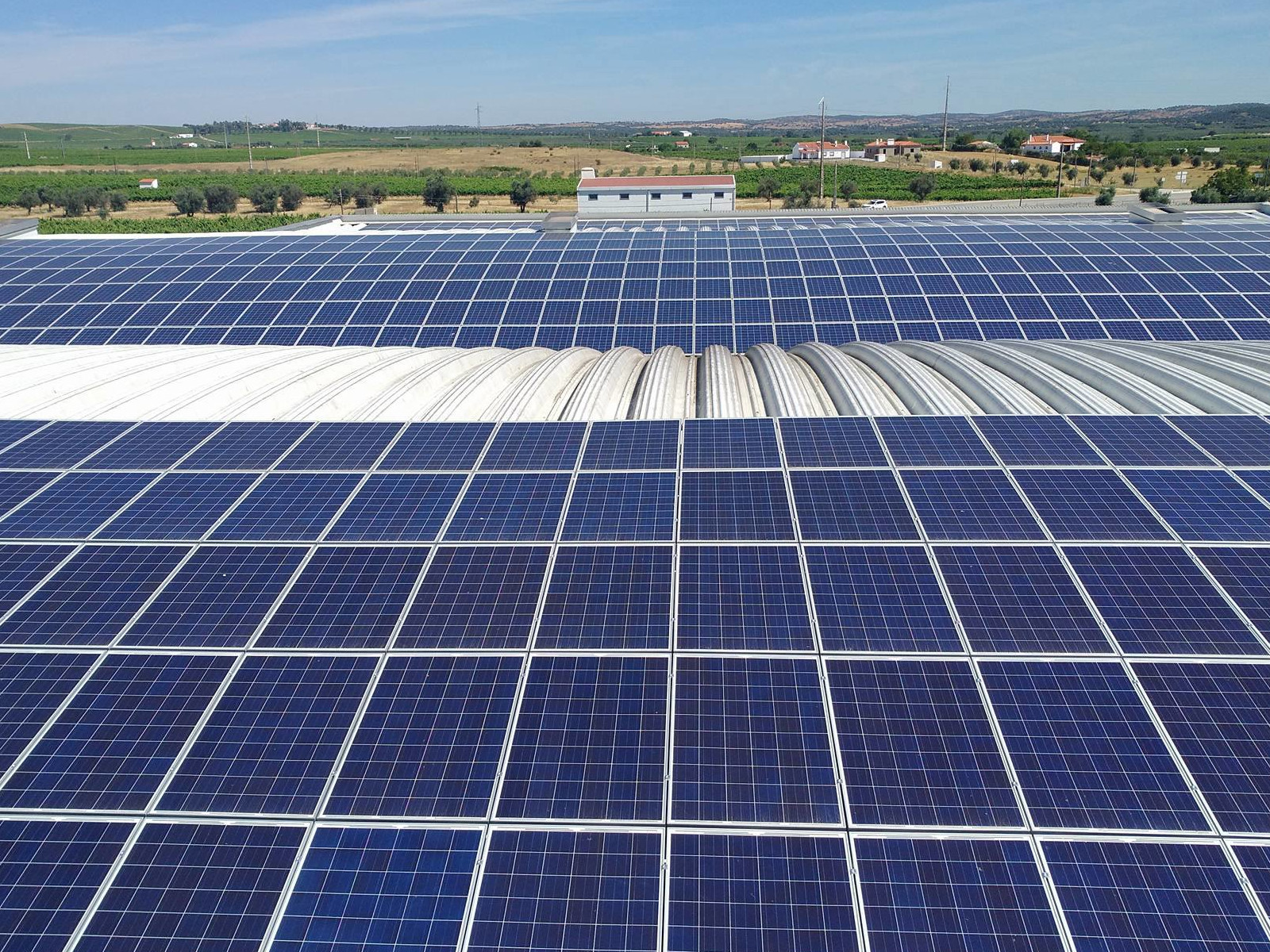
The 360º maintenance programme covers panel cleaning, connection and bonding checks, ground and aerial thermography, and advanced predictive fault detection analysis. Maintenance is what guarantees your installation's performance and safety.
Lobosolar uses essentially European reference manufacturers, taking into account energy performance, financial return, and the safety of the installation and people. Manufacturers' ESG performance is a crucial factor in project development strategy, alongside cybersecurity considerations and compliance with the NIS2 directive.
Talk to your Project Manager and receive a personalised technical proposal, with no obligation.
Responsible for the Group's web pages:
Lobosolar, Energias Renováveis, Lda
Zona Industrial Almeirim
Rua Sebastião Mendes Bolas 18
Apartado 332
7002-506 Évora
Portugal
Phone +351 266 771 427
webmaster@lobosolar.com
VAT: PT 504 892 711
All rights reserved. The texts, images, sound, animations and videos, as well as their arrangement on the Lobo Group's websites, are protected by copyright, related rights and other commercial protection rights. The content of these websites may not be copied, distributed, altered or made accessible to third parties for commercial purposes. Some Group websites also contain images subject to third-party copyright.
Unless otherwise specified, all trademarks on the Group's websites are protected by trademark law. This applies in particular to the marks, logos and emblems used on our site pages, which are the intellectual property of the respective company.
This website has been built with the utmost care. Nevertheless, the accuracy, correctness and completeness of the information provided cannot be guaranteed. The Lobo Group companies hereby exclude any liability for damages resulting directly or indirectly from the use of this website, except in cases of intent or gross negligence on the part of the company.
The intellectual property contained on the websites, namely patents, trademarks, copyright and related rights, is protected. This website does not grant any right to use the intellectual property of the companies or of third parties.
The European Commission provides an online dispute resolution (ODR) platform, which serves as a single point of contact for the out-of-court resolution of disputes relating to contractual obligations arising from online sales contracts.
In the event of a dispute, the consumer may turn to CNIACC – the National Centre for Information and Consumer Conflict Arbitration.
Address: Faculdade de Direito da Universidade Nova de Lisboa, Campus de Campolide, 1099-032 Lisbon — Contact: +351 213 845 131 — Email: cniacc@fd.unl.pt
The Lobo Group thanks you for your interest in our company and our products, as well as for visiting our websites. We respect your privacy. Protecting your privacy when processing your personal data is an important concern to which we pay special attention during our business processes. Personal data collected during visits to our websites is processed by us confidentially and in accordance with applicable law. Data protection and information security are part of our company's policy.
Personal data is only stored when voluntarily provided, for example as part of a contact request or a technical study request. In addition, the following information is collected: IP address, the website you came from (referrer), pages viewed, files saved (downloads), individual links clicked, words or phrases searched, length of visit, browser used, among others. If the visit results from online advertising, we also record what prompted the visit to the website. The insights gathered allow us to continue optimising our websites and adapting them to visitors' needs.
We use cookies and active components (e.g. JavaScript) to track visitor preferences and optimise website design accordingly. Cookies are small text files stored on your computer, which you can delete at any time — although this may disable some features. You can manage cookie use via the cookie settings link in the footer.
Some Group websites incorporate content and services from other operators (for example, YouTube, Facebook, Google), which may use their own cookies and active components. We have no influence over the processing of personal data by these operators.
The Lobo Group's websites may contain links to other websites run by operators not affiliated with us. Third-party behaviour is, by nature, beyond our control — the Lobo Group companies are not responsible for the processing of personal data by third parties.
We adopt security measures to protect the data we hold against manipulation, loss, destruction, access by unauthorised persons, or unauthorised disclosure. Our security procedures are continuously improved as new technologies become available.
You may withdraw your consent to the collection, processing and use of your personal data at any time. Personal data will be deleted if consent is withdrawn, except where storage is required for billing, accounting or other legal obligations.
To obtain information, or to send suggestions or complaints regarding the processing of your personal data, you may contact our Data Protection Officer using the contact details provided above.
A cookie is a small text file that a website stores on your computer or mobile device when you visit it. It allows the site to "remember" your actions and preferences over a period of time, so you don't have to re-enter them every time you come back to the site or browse from one page to another.
WordPress session cookies, used only when you log in to the Client Area or the site's admin panel. These are essential for that functionality and cannot be disabled without preventing access to those areas.
We load fonts (Google Fonts) and a flag icon library from external servers (Google and a content delivery network — CDN) so that the site displays correctly. Loading these resources may involve transferring your IP address to those servers when the page opens.
We do not use advertising cookies, nor tracking cookies for marketing or behavioural profiling purposes.
You can manage, block or delete cookies at any time through your browser settings — instructions vary by browser (Chrome, Firefox, Safari, Edge) and are available on each browser's official support site. Note that disabling essential cookies may prevent some areas of the site, such as the Client Area, from working.
We may update this policy from time to time, to reflect technical or legal changes. We recommend checking it periodically.
For any question about this policy, contact us at comercial@lobosolar.com.
Choose a day and a time — our team will confirm by phone or email.
Available time slots
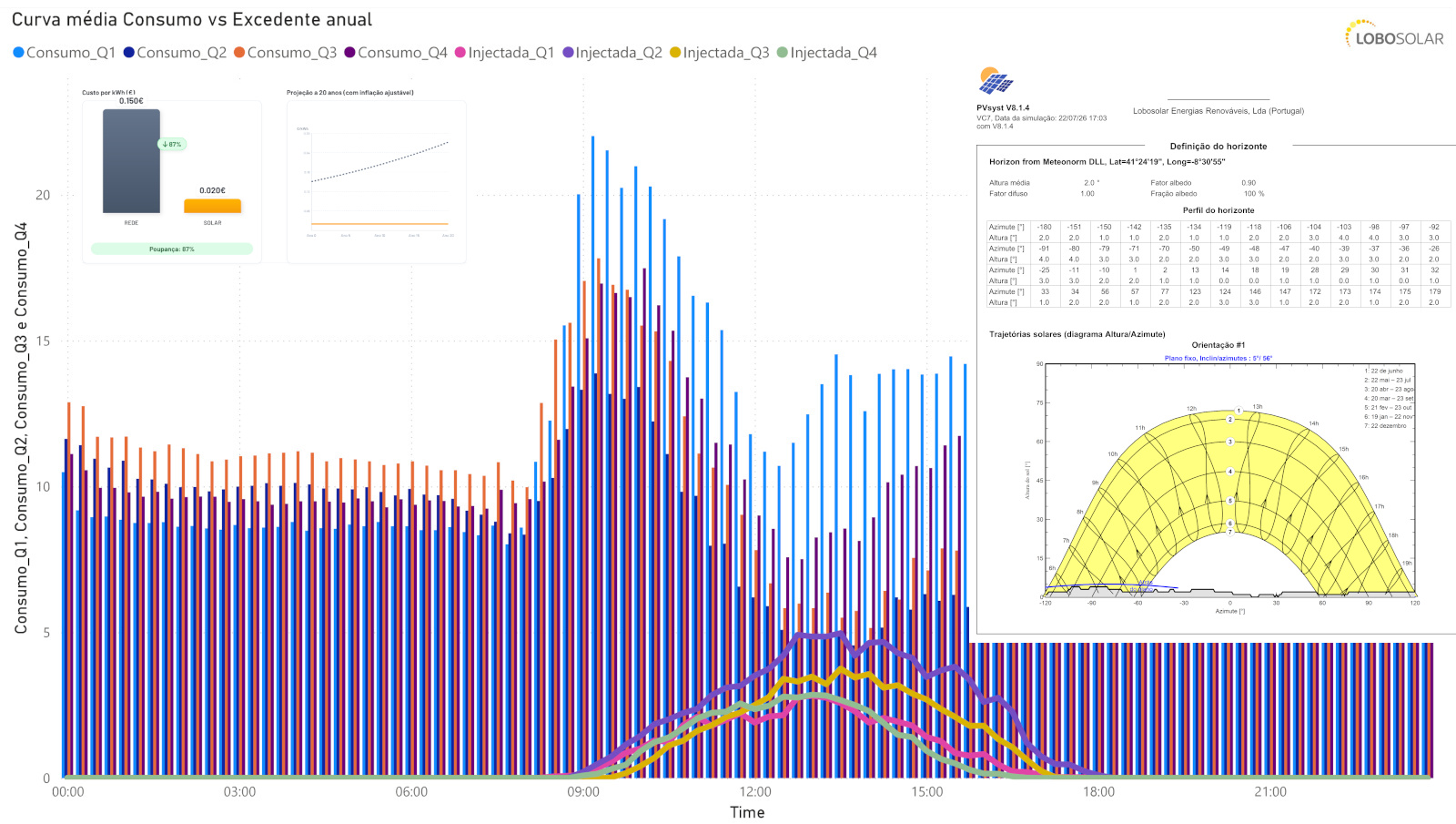
A 360º scientific approach to maximising environmental and economic sustainability indicators. Simple estimates based on bills, often built on inaccurate data, aren't enough for those seeking excellence.
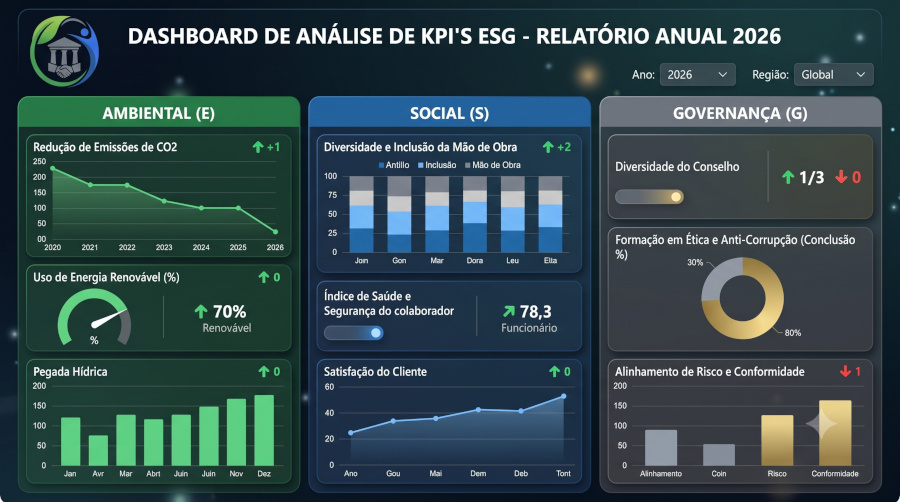
ESG stands for Environmental, Social and Governance. These are the three criteria increasingly used by investors, banks, clients and partners to evaluate a company beyond its financial results.
It's not a passing trend: it's a growing requirement for accessing financing, public tenders and international markets — and a direct way to reduce regulatory and reputational risk. Companies that can demonstrate real (not just declared) commitment gain a measurable competitive advantage.
The Environmental (E) pillar is today the most visible and easiest to prove with concrete figures — and that's exactly where we come in: own generation, storage and energy efficiency are direct, verifiable indicators of environmental commitment, not vague promises.
This is where Lobosolar comes in: we design the energy strategy that underpins that part of your ESG narrative — sizing the right generation and storage for your real consumption, delivering the production and CO₂ reduction figures you can report to investors and clients, and providing the ongoing technical support (O&M) that ensures those figures hold up year after year. A winning ESG strategy isn't built on good intentions — it's built on engineering and verifiable data, and that's what we deliver.
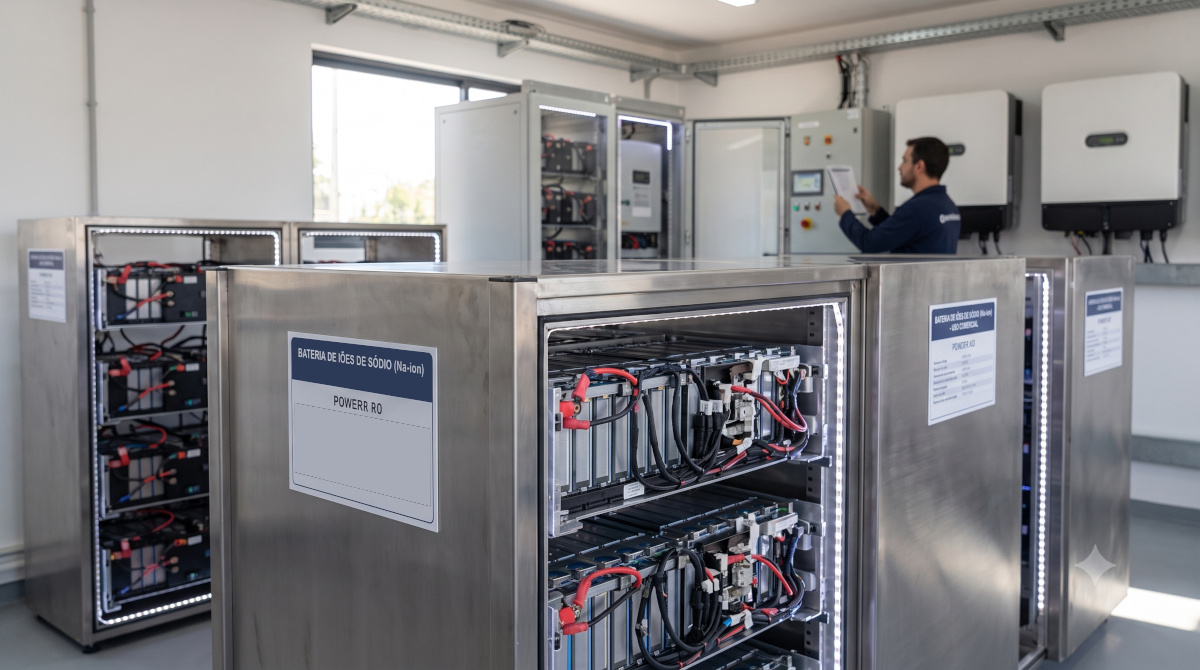
Storage is the piece that turns a photovoltaic system into a genuine energy autonomy strategy — and it's an area where technical expertise makes all the difference between a battery that delivers what it promises and one that falls short.
Lobosolar follows the evolution of storage from the most established technology — lead-acid, still relevant in specific low-cost applications with predictable cycles — to today's most advanced solutions: lithium-ion (currently the benchmark for energy density and cycle life across most commercial and industrial applications), flow redox (suited to long-duration storage and high cycle counts, with minimal degradation over the years), and sodium-ion (Na-ion), an emerging technology that reduces dependence on critical raw materials and offers good thermal response.
This technological range allows us to recommend, for each project, the battery chemistry that truly fits your consumption profile, your goals, and your company's financial and environmental performance.
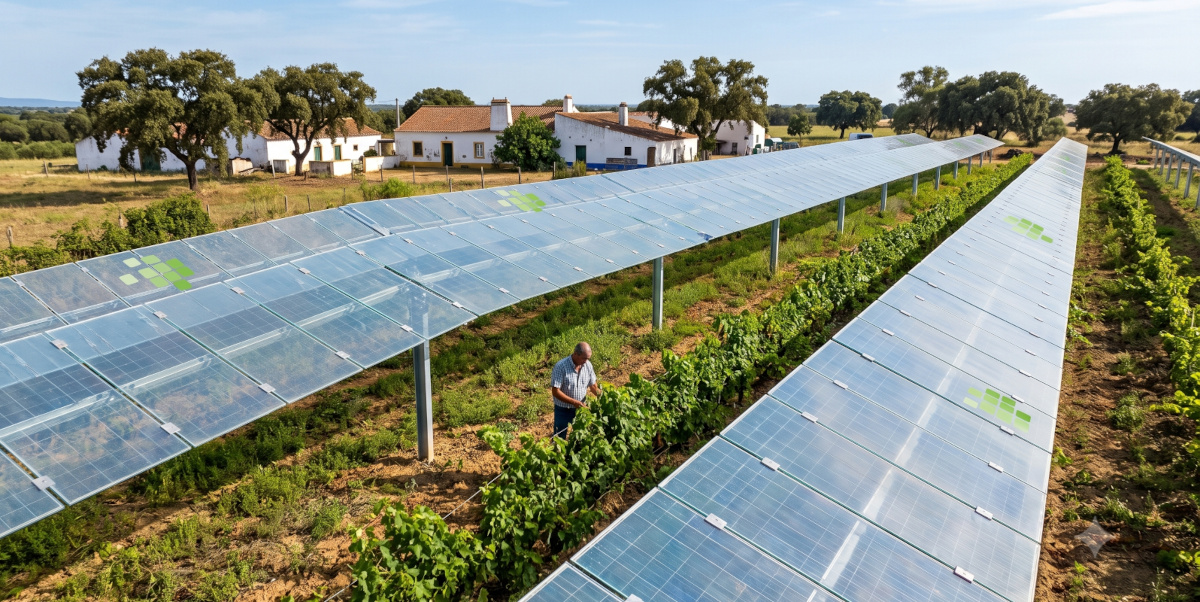
Agriculture and solar energy no longer have to compete for the same land. With well-designed agrivoltaic systems, Lobosolar helps make use of the same soil to produce clean energy while, at the same time, reducing pressure on natural resources — fewer gas emissions, lower water consumption, and less impact on soil and air compared with conventional generation or irrigation alternatives.
The elevated installation of the modules also has a direct effect on agricultural productivity: shading management reduces water and heat stress on crops during heat peaks, can reduce soil evapotranspiration, and partially protects crops from extreme weather events — all without taking the land out of agricultural use.
The result is a dual land-use strategy: the same area generating energy revenue while supporting (rather than compromising) the farming activity that was already there.
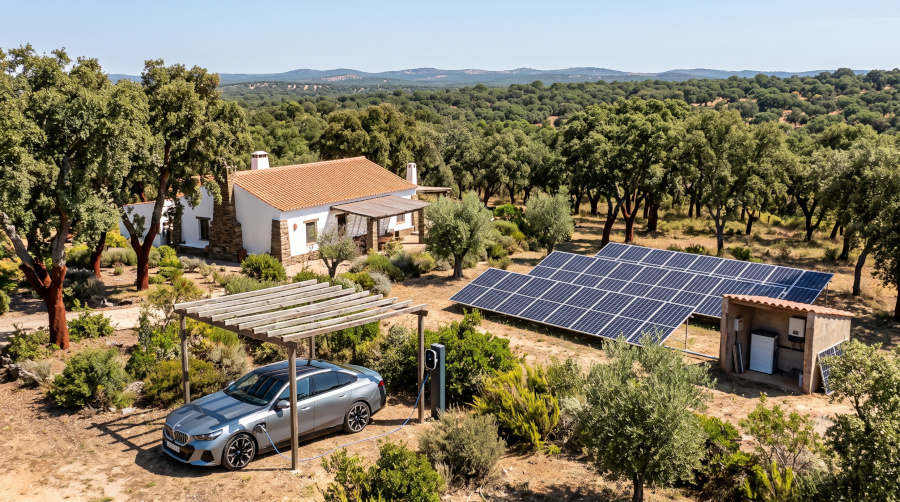
There are places the electrical grid simply doesn't reach — or where reaching them costs more than it's worth. An off-grid system solves this at the root: it generates, stores and manages its own energy on site, without depending on a connection that may never exist.
That means real energy independence — homes, farms or isolated facilities with electricity, pumped water, climate control and even electric vehicle charging, all running without a single metre of cable to the public grid.
Lobosolar has hundreds of off-grid systems in operation — it's not a pilot project or an exception, it's one of the areas where we have the most years of accumulated experience, with rigorous sizing to guarantee real autonomy at any time of year.
Describe the problem or request — our technical team will get in touch to schedule the intervention.
Send us your details and your CV — our team will get in touch if a suitable opportunity comes up.
This website uses its own and third-party cookies to function properly. See our Cookie Policy to learn more.